OSCAR Celebration of Student Scholarship and Impact
Categories
College of Engineering and Computing College of Science Patriot Green Fund

Data Logging in a Hydroponic Greenhouse

Author(s): Franklin Farrel, German Kuznetsov, McKenna Olsen

Mentor(s): Nathalia Peixoto, College of Engineering and Computer Science

Abstract
George Mason University’s hydroponic greenhouse and the Patriot Green Fund requested an irrigation data logging system to track how weather conditions affect the frequency at which plants need to be watered. A prototype system was created, and tested in the greenhouse. The initial prototype was found to have significant issues, and was brought back to the lab for modification. Upon testing in the lab, it was found that the sensors worked as expected; further testing is required to determine why this is. This project has wide implications in the field of sustainability, as it could be used in medium- and small-scale hydroponics operations across the world.
Audio Transcript
Hello everyone, my name is McKenna Olsen, and my teammates German Kuznetsov, Franklin Farrel, and I are working on a project called Greenhouse Irrigation Data Logging. We’re supervised by Nathalia Peixoto with OSCAR’s Summer Team Impact Projects, Sarah d’Alexander with the Patriot Green Fund, and Donielle Nolan with the President’s Park Hydroponic Greenhouse.

We’ve spent 10 weeks of this summer trying to create a system to log data on temperature, humidity, and moisture levels in the President’s Park Greenhouse. The ultimate goal of this project is to discover how weather conditions affect moisture levels in the hydroponic trays and therefore how often plants in the greenhouse need to be watered.

Our initial goal was to create a system that would both log data and use that data to determine the intervals at which watering should occur, however we quickly realized that we were getting ahead of ourselves. No one had collected data of this sort in the greenhouse before, so we didn’t have a baseline to work off of. So, we set out to create that baseline for other students and staff to work with in the future.

Now, filming from the greenhouse, I wanted to show y’all the system we’re working with. This is essential to our project, as whatever we make should integrate seamlessly into what the greenhouse already has. Nutrient-enriched water flows from these bins into the hydroponic trays above, where it reaches the plants – there’s nothing in them now, but during the school year they’ll be overflowing with amaranth, basil, and even sunflower sprouts! The plants get watered about 7 times a day, but due to changes in light, temperature, and humidity, this can end up being either too much or too little. These trays are where we tested our prototype system.

Many plants, particularly young seedlings, are incredibly sensitive to water levels. Overwatering can cause problems such as root rot or disease, and under-watering causes the plants to wilt. Either way, the greenhouse won’t produce as much, and will earn less money off the product.

Our prototype system, pictured earlier and tested here in the greenhouse, allowed us to learn a lot about collecting data in the greenhouse; we learned that we would have to take into account waterproofing, the chemical properties of the nutrient solution used to water the plants so as to prevent corroding of our equipment, and even things as simple as where to place the system so it wouldn’t be disturbed, or where to plug it in.

Unfortunately, we did not acquire any viable data from our first prototype upon testing in the greenhouse (however, we did acquire some useful data from commercial sensors we had placed in the greenhouse for comparison). We found that, as we expected, temperature in the greenhouse rose and humidity dropped throughout the day, meaning that water would likely evaporate faster during these hours (from about 10AM to 4PM), and slower at other times. This would indicate that the watering schedule could be altered to help accommodate this difference, although more data should be collected on differing weather conditions and during different seasons. Rain, snow, cold snaps, cloud cover and wind – there are innumerable ways all of these conditions could affect the data collected.

We hope that the work we’ve done this summer provides a platform for other students, staff, and faculty to collect more data and improve upon the system we’ve designed. We believe that there are numerous potential uses for this system, from allowing staff to monitor moisture levels when the greenhouse is closed, to helping students design even more helpful systems for the greenhouse.

We would like to sincerely thank OSCAR, the president’s park greenhouse, and the patriot green fund for allowing us the opportunity to work on this project.
Categories
College of Engineering and Computing Patriot Green Fund

Filterra Sign PGF

Author(s): Ziya Zulfugarov

Mentor(s): Brenda Claudio, Mason’s Land Development office at Facilities

Abstract
This project’s purpose was putting a sign next to the existing Filterra unit locate in Lot P. The sign would be helpful for informing Mason’s community about how important it is to keep the stormwater clean from pollutants and how it can be achieved through the Filterra. The goal of this project was to provide outreach information to the public on how this sustainable technique helps with the stormwater management. The economic aspect of this project was providing information to the public on how to minimize the pollution by good manage of trash and carbon footprint. It would minimize Mason’s costs on maintenance of the unit if people help by following recommendations in the sign. I researched the VA design specifications for bio retentions, Filterra’s manufacturer manuals and Lot P improvements project record drawings. I also performed maintenance to the unit to understand more of its functions. Thought that to have an educational sign next to it would make the community attending the baseball field activities, students and faculty using the parking lot understand the sustainable stormwater management performed by the university through this unit. This project will have a positive impact on Stormwater management in GMU West Campus. It will allow Mason to keep the stormwater both, clean and more manageable.
Audio Transcript
Today I will be presenting my project that I did for Patriot Green Fund. I made an educational sign to the Filterra stormwater system located on Lot P GMU West Campus. The sign provides information on the Filterra’s functions, maintenance and pollutant management. The Filterra is a manufactured stormwater facility used for removing pollutants before they reach the stormwater system. The goal of my project was to provide an outreach information to the public on how this sustainable technique helps with the stormwater management. The economic aspect of this project is providing information to the public on how to minimize the pollution by good management of trash and carbon footprint. This would minimize Mason’s costs on maintenance of the unit if people help by following recommendations in the sign. Now the sign is installed, Mason LD would inspect and document the maintenance conditions and needs. Mason LD will observe if the conditions were improved or not by adding the educational sign.
As the sign suggest, we ask everyone to please:
• Do not litter
• Avoid dumping waste materials
• Keep your car tuned-up
• Keep your car tuned up so it runs properly for less pollution
• Wash your car regularly with biodegradable soap
• Carpool, walk, bike or take a bus if possible to reduce carbon footprint
Categories
Carter School for Peace and Conflict Resolution OSCAR Top Presenter Patriot Green Fund

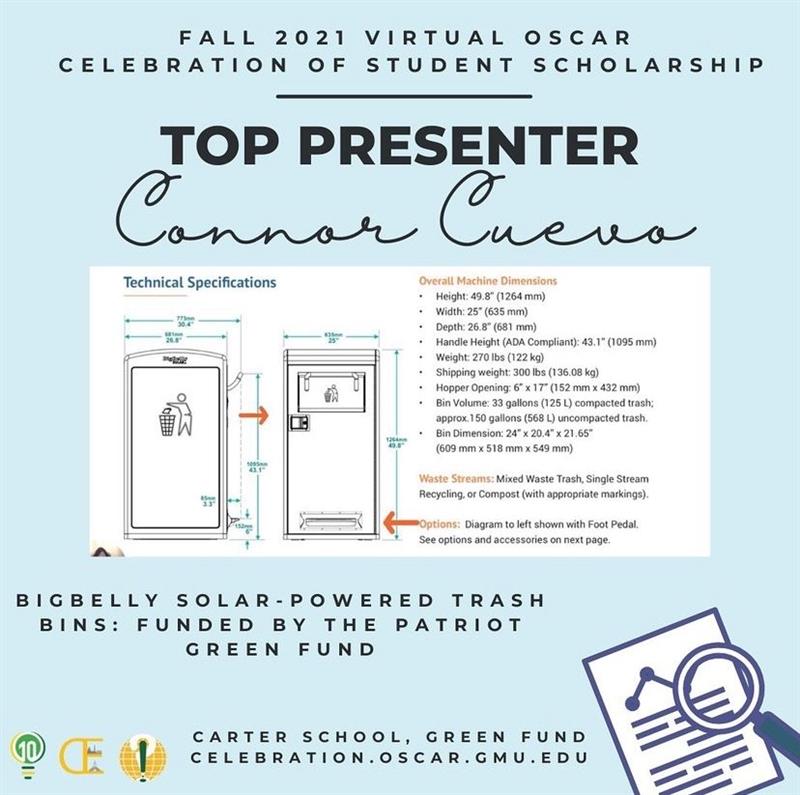
BigBelly Solar-Powered Trash Bins: Funded by the Patriot Green Fund.

Author(s): Connor Cuevo

Mentor(s): Amber Saxton, Office of Sustainability

Abstract
You may have noticed something new on campus: BigBelly waste bins! But what are they. Approved for university funding by the Patriot Green Fund, these new-fangled receptacles are Mason’s latest commitment to sustainability on campus. A small team of dedicated individuals working in conjunction with the office of sustainability brought this project to fruition. The need for a more innovative trash can was realized in the last few years as a burgeoning student population pushed trash infrastructure to its limits and a wave of scavenging critters menaced traditional waste units. By contacting other universities, cities and institutions, the team was made confident that the Bigbelly units would make an excellent addition to the Fairfax Campus waste stream. But in order to be approved for funding, some issues needed to be tackled first. The facilities department had to approve the installation, the funders had to make sure it was a competitive offer and the university had to know how many units to buy. The group decided that the project had the best chance of success as a pilot program with the potential for further funding. Complicated by supply chain issues and stalled by a global pandemic, the effort to install BigBelly waste units on campus began in earnest in January 2020 and came full circle in July 2021. Additional challenges included writing a formal contract with the vendor, obtaining offers from competitions to ensure a favorable market rate for the product, and multiple meetings with a dedicated design to team to ensure the trash cans looked stunning. These BigBelly units show that George Mason university is fully backing a transition to a sustainable future. The Patriot Green Fund is an excellent opportunity for students to apply their skills and put their ideas to work.
Audio Transcript
If you’re a student on the Fairfax campus, and you’ve walked by Northern Neck Hall this semester, you’ve probably wondered “What are those weird looking trash cans?” What if I told you it was a student like you who got them installed?

The University facilities team sets aside $100,000 per year in an independent organization known as the Patriot Green Fund. Run by a dedicated committee of faculty, staff and students, this fund identifies areas of infrastructure improvement on George Mason University campuses. It accepts, critiques, selects and finances creative, innovative, and eco-friendly solutions to these issues submitted primarily by students.

I and my team had the honor of being awarded university funding in the spring of 2021. We proposed a pilot program to assess the performance of a solar powered, self-compacting, high capacity trash receptacle to be installed outside of the Starbucks in Northern Neck hall.

I was approached almost two years ago in January 2020 by Sustainability Program Manager Amber Saxton, who notified me of several areas of potential campus improvement. I decided to explore alternative waste receptacles, due to the high costs and environmental impacts of providing liners for current trash bins and the frequently arising need to empty them, as well as rising complaints about litter and scavenging animals. After cursory research of the problem, an independent vendor known as BigBelly Solar seemed to provide a creative, sustainable and cost-effective solution.

BigBelly units are large trash cans that compact the trash inside them. They are fully powered by renewable solar energy and hold nearly twice as much as standard campus trash bins, meaning less work and money saved for the university. A metal hatch seals the units to prevent access by pests and ensures that what goes in, stays in.

Amber introduced me to Colleen Regan, the Campus Efficiencies Assistant, who helped me conduct research and draft a proposal. Together we reached out to cities, universities and institutions all across the country who had previously purchased these units and asked all manner of questions about their specifications, cost, performance and maintenance. I also reached out to BigBelly directly for more information on their products. During this period, the three of us identified additional benefits of purchasing BigBelly units, such as a built-in ashtray, a foot-pedal to activate the hatch, and advertising space on the sides. Colleen and I determined that the University should purchase one trash bin and one recycling bin situated beside each other, with the future possibility of a compost receptacle or additional bins located elsewhere.

Amber, Colleen and I drafted a proposal. Before we began, I had the opportunity to meet with Sarah D’alexander, the Director of the Patriot Green Fund. Sarah explained to me that I would need to pass a preliminary round of examination by the committee to advance and become a finalist. My team and I worked hard to explain the problem and demonstrate our solution. The hardest part was crunching the numbers and determining that BigBelly would pay for itself in the span a of a few years. We submitted our proposal and patiently awaited a response.

However, before the committee could meet and assess our proposal, the covid-19 pandemic was gripping the US. Months of patiently waiting went by, before one day in July 2020, I received an email that the proposal had passed the initial stage and was a strong candidate for funding. Unfortunately, the pandemic was the cause of further delays both at Mason and across the globe, and it was not until the spring that we found the opportunity to make progress.

We got to work on the final proposal, amending our original draft and adding features such as a map to depict the waste bin’s location, and a chart which both detailed and provided a rationale for our expenditures. We explained each of our roles in the final application and demonstrated our commitment to see the project to completion. On February 5th, 2021, we submitted our final draft of the funding application.

Only a week or so had gone by, before I received an email from Sarah, informing me that the final application had been approved for funding. In class at the time, I nearly jumped for joy when I saw the notification. I was very proud of myself and my team. I couldn’t believe that I had won the first grant I had applied to! But I had to remind myself that my work was not done; I needed to follow through on what I had promised to deliver.

A few days later, I met with my team and with Sarah. We discussed the final three action items. First, we had to prove that our proposal was financially competitive, and this we accomplished by contacting two vendors who provide similar product and determining their prices. Second, since Bigbelly had no contract with George Mason University, we needed to provide one. Luckily, we located a similar contract with the vendor from an out of state organization which we were able to adapt to our own purposes. And lastly, we had to schedule several meetings with a university graphic design team to develop a durable, informative and visually appealing exterior for the Bigbelly unit.

Finally, in July 2021, the big day arrived. The facilities team led by Kevin Brim, head of campus recycling, installed the units right next to the Northern Neck Starbucks. Since then I have had the responsibility of continuing to monitor them; making sure that they are in efficient, working order, as well as checking for contamination. One area that needed troubleshooting was to determine the ideal level of waste and recycling the units can hold before they need to be emptied. Along with my team, I have participated in “waste audits” which involve digging through the trash and recycling to monitor contamination, as well as to assess the practicality and durability of the units.

But most of all, this is a pilot program, and if the units perform well, the university will consider expanding the project. BigBelly waste bins are a clear and visible symbol of Mason’s commitment to sustainability and innovation. The Patriot Green Fund is just one of many opportunities Patriots have to effect change on campus and beyond. Who knows what will be next?

Categories
College of Science Patriot Green Fund

Organic matter, carbon content, and color variables of soils of 17 green spaces on the Fairfax campus at George Mason University

Author(s): Aysan Yazdanpanah

Mentor(s): Dr. Changwoo Ahn, Environmental Science and Policy

Abstract
Healthy soil is needed in order to have food security and carbon storage. Due to the current climate crisis, food security and soil health are important issues that should be addressed. Healthy soil is measured through the amount of organic matter and organic carbon content that is present in it. 17 different locations were chosen across the George Mason Fairfax campus based on the level of human impact and the amount of maintenance put into each space. Soil cores at two different depths (0-15cm and 15-30cm) were taken for soil organic matter (SOM) and Carbon-Hydrogen-Nitrogen (CHN) content analysis. With the use of an inexpensive device called the NIX Pro Color Sensor, the soil color was recorded at the 17 different sites at George Mason University, Fairfax campus. Using the loss of ignition (LOI), the SOM was measured and recorded. Through the use of CHN Analyzer, the amount of organic carbon was determined and recorded. The overall results showed there to be a distinct positive relationship between SOM and carbon content in all green spaces. The areas that are either less disturbed or highly managed showed the highest content of SOM and carbon, indicating that landscape management may have a significant influence on soils’carbon storage potential although it is still preliminary. Further data analysis is warranted, including the examination of the relationships between SOM and the NIX soil color variables. Site-specific limitations and short periods of testing are some of the limitations that this study faced.
Audio Transcript
Hello everyone this is our presentation on soil organic matter and carbon contact on the GMU Fairfax campus and us 3 had help from Dr. Ahn and Stephanie Schmidt.
These are all the locations that we sampled from in the summer and as you can see there is a lot of variation in the location itself and our original hypothesis believed that the higher coverage in the canopy and shrubby, the higher the SOM content would be in the soil.
So the darkest points on the map represent the highest canopy cover and the lightest green represent the lowest canopy and shrubby cover.
And so here are the pictures of the physical locations.
As you can see again there is a lot of variation in each location. For example, at the top center, the RAC location is a lot more coverage and less foot traffic than the Lecture Hall location. There is obviously maintenance with mowing and a lot of people use that too and get to the classes and move from Blue Ridge to the main part of campus.
So for the methods of this study, we basically collected soil cores from those 17 locations in two different depths from 0 to 15 and 15 to 30 cm and we weighed those samples when they were wet and also when they were dried and then we use the furnace at 550 ° C and about 5 g of the soil to find out how much organic matter content was in each of those soil cores and all the samples about 8 mg were weighed and put in the C H N analyzer in order to find out how much carbon-hydrogen and nitrogen was in each soil core.
We came up with this chart which basically talks about how Potomac Heights garden innovation food forest and wetland mesocosm compound has the highest SOM percentage and carbon content while on the other hand the parking lot L parking lot K and aquatic fitness center and lecture hall had the lowest SOM percentage and carbon and the graph on the left shows that SOM and Carbon are positively correlated with 7 8 % which is the R squared and on the right, we have a SOM and carbon in each of them in each different location and plot and here we have the Carbon and SOM average from 0 to 15 and 15 to 30 cm from the highest which is on the left PHG stands for Potomac Heights garden and all the way to PLK which is parking lot K which is the lowest SOM and carbon.
This is just a map of the 17 locations with the darkest color brown being the locations that have the highest soil organic matter the lightest brown locations being the ones that had the lowest soil organic matter.
As you can see the West campus areas like the wetland mesocosm compound were the ones that had the higher soil organic matter with the main locations that were in the center of campus.
Really having the least soil organic matter which shows foot traffic and human presence in these areas and it does have an effect on the amount of nutrients present.
This is a table of all the color sensor variables we did take color readings of the soil when we took the cores in the field. Right now we’re still working on the data analysis and relationship between them so we don’t have anything definitive currently.
So like I just said we don’t have any clear relationship between those color variables and it is still in process but we do have a clear positive trend between soil organic matter and carbon present in the soil. Soil organic matter really is highest in undisturbed locations like a wetland mesocosm compound.
For the highly maintained areas like the garden in the center of campus and Soil organic matter really is lowest in spaces that are highly disturbed due to mowing or foot traffic like the lecture hall location which really means that George Mason has a lot of room for improvement of its ecosystem for carbon storage to offset its emissions. We thank you so much for taking the time to watch our presentations and look forward to hearing any questions.
Categories
College of Science Honors College Patriot Green Fund

Bee Hotels in GMU’s Innovation Food Forest

Author(s): Jackie Luu

Mentor(s): Sarah D’Alexander, Office of Sustainability

Abstract
Bees play an important ecological role in terrestrial ecosystems as pollinators where they assist with the fertilization of plant species. Due to unsustainable use of pesticides, agricultural practices and habitat loss, native bee populations have been steadily decreasing. In an effort to maintain and promote native bee populations, George Mason University’s Office of Sustainability built bee hotels in the Innovation Food Forest to provide an area for native bees to live. However, bee hotels on GMU’s campus have not been properly maintained and are in need of serious repair, thus impeding native bee populations. The construction of the bee hotels would serve two main functions: immediate aid to the native bees on GMU’s Fairfax campus and showing the local community the importance of native bees to the local ecosystem. The two bee hotels on the Fairfax campus will be replaced and a volunteer program will be created on campus to enable future maintenance of the bee hotels.
Audio Transcript
Hello, we are team beelonging, and this is a quick summary of our START project: Bee Hotels in the GMU Innovation Food Forest.

The problem we faced was the decline of local bee populations on campus due to habitat loss and pesticides. These bees either assist or are essential to the local plant population’s fertilization process and so are essential to SDG 15: life on land. To counter the declining bee populations, bee hotels can be built to provide optimal nesting material and shelter. However, despite a number of these hotels being built on campus, they have fallen into disrepair.

The root cause of this issue can be traced to either a lack of volunteer help maintaining the hotels or the poor materials used in the hotel construction. In order to combat these issues, we developed five action plans. From these plans, we took bits and pieces from each to make what we believed was the best course of action: research the optimal bee hotel design and replace the new hotels with old ones. Plans to introduce volunteer work to upkeep the hotels would have to come later, as replacing the hotels already took up plenty of time.

I’m going to talk about some of the milestones we achieved while working on this project. At the beginning of the semester, we began by assessing the location and damage to the bee hotels in the Innovation Food Forest and compiling information from the literature and prior bee hotel projects to get adequate background information. We then worked on getting funding to purchase the bee hotels and other necessary materials by applying to George Mason’s Patriot Green Fund. While we were working on completing the green fund application and waiting for it to get approved, we met with experts such as German Perilla who is the Director of the Honey Bee Initiative. He provided us with useful recommendations on the proper placement and materials for bee hotels. We also worked on creating a guidebook that details all of the information my team has collected from the literature and experts on the proper placement, design, and maintenance for the bee hotels. We plan to pass this information on to the next group who will hopefully take on this project.

The actions we took mainly consisted of contacting professionals on campus, such as German Perilla or Donielle Nolan, to collect data on a better hotel design and where to put them. In addition, we collected data from research papers, such as Fortel’s paper comparing a number of preexisting bee hotel designs. The rest of our time was spent applying for the Patriot Green Fund, which would fund the project.

So based off our research and meetings with experts, we found that the best time to install the hotels was late February or March. The best place for them is in the Innovation Food Forest where there is adequate sunlight and that the hotels face south for maximum exposure. We also found that natural materials are better, and that tubing needs to fit certain dimensions to increase the likelihood that native species will utilize the hotels.

We decided to not install the hotels ourselves because the timing was not right to place them in the Food Forest based on our research. We decided that it would be best to develop a guidebook that can be used as a reference for groups or volunteers to both install and maintain the bee hotels in the future. We also thought using premade hotels would be easier and cheaper pilot study to implement if the bee hotels will have a positive impact.

The biggest lesson that we learned was that initial plans may not be entirely feasible, and that it is important to be able to adapt those plans to ensure that our goals may be accomplished in the future. This realization also gave us a better understanding of sustainability in action because the most important aspect is that it can be continued and expanded on. Lastly, it is important for us to record our obstacles and how they were overcome so that future groups have access to those solutions if the same obstacles happen again.

The next steps for this project include determining the locations in the Innovation Food Forest where the bee hotels should be placed, confirming which bee hotels should be purchased, and then to actual implement the project by installing the bee hotels in the spring and ensuring that there is a plan for perpetual maintenance. Some recommendations we have for the next group is to purchase bee hotels instead of constructing homemade ones, look into placing the bee hotels on platforms instead of just nailing them to trees, maintain contact with the Office of Sustainability to see if you could possibly coordinate a volunteer program with them, and to create maintenance log to ensure that the bee hotel tubes are replaced on time. Thank you for listening to our presentation and I hope you learned something new about this project to aid the native bees on campus.