OSCAR Celebration of Student Scholarship and Impact
Categories
College of Science OSCAR Top Presenter Undergraduate Research Scholars Program (URSP) - OSCAR

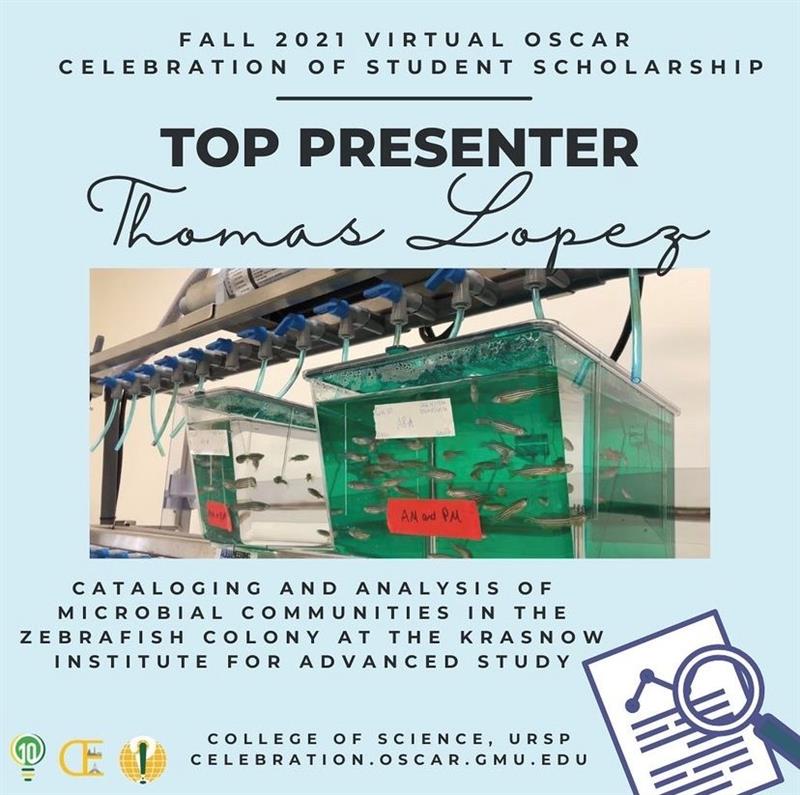
Cataloging and Analysis of Microbial Communities in the Zebrafish Colony at the Krasnow Institute for Advanced Study

Author(s): Thomas Lopez

Mentor(s): Dr. Valerie Olmo, Biology

Zebrafish (Danio rerio) are important model organisms for studying developmental biology. The Krasnow Institute for Advanced Study (KIAF) at GMU houses a colony of zebrafish in their animal facility. The research presented here is part of a greater review of care protocols in order to reduce mortality rates in juvenile fish. Several samples of microbial biofilm were harvested from the aquarium system housing the fish and cultured in petri dishes at 28℃. The goal was to check for any pathogenic organisms, but none were found. Instead, investigators discovered a high diversity of microfauna that organize themselves into three distinct communities based on water conditions and quality. Type I communities were observed in conditions that zebrafish thrive in, Type II communities were observed in conditions that zebrafish deteriorate in, and Type III communities are neutral to water quality and instead react to ambient light levels. Based on these findings, zebrafish researchers at the KIAF can use microbial analysis to monitor water quality and better diagnose issues with the fish by cataloging the presence of Type I and II communities. Investigators hope that the application of these culture techniques will improve survivorship in both adult and young zebrafish at the lab.
Hello, my name is Tom Lopez and I’m currently a junior biology student at George Mason University. Today I will be presenting the cataloging and analysis of microbial communities in the Zebrafish Colony located in the Krasnow Institute of Advanced Study.

I originally applied for the OSCAR URSP Program with my mentor Dr. Valerie Olmo with an idea for a conservation biology project about an endangered and understudied species of fish. While I set up my own research project, Dr. Olmo invited me to work with the Zebrafish Colony. The researchers there were struggling to raise young fish, so she asked me to help review their care strategies. I tested different factors while raising several clutches of eggs, including water quality, feeding regimes, and disinfection protocols. While investigating the high mortality rate of young fish, I began to look at the microbial organisms that inhabited the aquarium system. I initially wanted to see if there were any pathogens or other harmful organisms which may be affecting the fish. I did not end up finding anything dangerous, but I did discover a much wider variety of biodiversity than I expected. This presentation will explore these findings.

Aquariums support many different types of microhabitats, oftentimes unintentionally. The constant flow of nutrients in the water supports several communities of microorganisms, which form biofilms across surfaces. I sought to identify exactly what organisms comprise these biofilms.

To do this, I collected several samples by scraping the biofilm off the surface, pipetting it into a petri dish, and incubating the dishes at 28 degrees centigrade. After leaving the contents of the dish to settle for 24 hours, I looked at them under a dissecting microscope. Immediately, I saw a huge diversity of life. I began recording them one by one in an effort to identify them. Among the species found living in the system were:

Tetrahymena pyriformis, a single-celled detritivore
Two kinds of rotifers, one in the class Bdelloidea and the other in the genus Euchlanis
An unidentified Vorticella species, which are sedentary filter feeders
Peranema, which are euglenids
Gastrotrichs, which are benthic worm-like animals
Non-parasitic nematodes

As I collected and analyzed more samples, I began to notice that the organisms divided themselves into three distinct communities, which I called Type 1, 2, and 3 for this project. Each community is associated with a different aquatic environment.

A Type 1 community is one which is dominated by an unidentified fungi. This organism grows in a mycelium-like pattern, branching across a surface like a web. This mycelium substrate hosts a variety of species, primarily Tetrahymena, Vorticella, gastrotrichs and rotifers. All of these organisms have been observed attaching to and living within the mycelium matrix, suggesting that the fungi provides some sort of critical factor for this ecosystem to develop.

A Type 2 community is one which is dominated by a bacterial biofilm. This film spreads like a sludge across a surface around uneaten food. This community hosts a lower diversity of organisms, but a much higher density. The primary organism in this ecosystem by a large margin is Peranema. Unlike their more well-known Euglena cousins, Peranema cannot photosynthesize, instead feeding on the bacteria which grow in the biofilm. Type 2 communities are visible with the naked eye, appearing as a brown slime dotted with several white masses. These masses are actually piles of Peranema, which congregate into these areas to feed and breed.

Type 1 and Type 2 communities are mutually exclusive, requiring different water conditions and actively repelling each other, as can be seen here. Type 1 communities have been observed in conditions with faster water flow, low nutrients from leftover food and low ammonia waste from the fish. By contrast, Type 2 communities have been observed in low-flow conditions with high nutrients and very high levels of ammonia waste. This distinction allows the communities to be used as secondary indicators by researchers to monitor aquatic health, since zebrafish thrive in the conditions preferred by Type 1 and deteriorate in the conditions preferred by Type 2.

Type 3 is an outlier community associated with high flow and high light. Only two have been observed in the system, but they were the two largest microbial communities documented. Type 3 communities are dominated by diatoms- tiny, photosynthetic ciliates which form silica shells around themselves. Samples from these communities were difficult to culture since the diatoms often died when kept in a dark incubator; however, I was able to identify the glass shells they left behind. The diatom colonies form a brown-red film which acts as a matrix for larger organisms to inhabit, primarily rotifers and a small unidentified plankton too small to record. They also seem to be associated with webs of thin red strands; these structures have yet to be identified, but are speculated to be another kind of fungi.

These are the findings I have compiled by the end of the semester. In regards to zebrafish husbandry in the Krasnow Institute, the ecology of these microorganisms can be used to improve care practices and better provide for the offspring. However, more work must still be done. There are several organisms which have not yet been identified, and the significance of the association with Type 1 and 2 communities and water quality has yet to be quantitatively determined. With further investigation of microbial analysis, researchers can use the health of all organisms in an aquarium system to better provide for the needs of the fish they want to raise. I will continue to move forward with this investigation, and I am excited to contribute to the husbandry of the model organisms upon which so much research relies. Thank you for watching!

Categories
College of Humanities and Social Science OSCAR Top Presenter Undergraduate Research Scholars Program (URSP) - OSCAR

The Aspera Group

Author(s): Casper Brooks

Mentor(s): Jessica Hurley, English

My project is a digital literary work surrounding one organization’s efforts to stop the apocalypse. This project displays a science fiction world through the lens of a corporate website. Through research into surveillance capitalism, historical views of monstrosity, and social movements around doomsday prepping, I have deconstructed the genre of apocalypse fiction to display it from a different angle and center the perspectives of diverse characters. The central character is a disabled trans woman struggling to control the organization she’s created as it spirals out of her control. I have stripped the genre down to the world-building by displaying this world in frame, because many aspects of science fiction and fantasy have historically had elements of race, sex, age, and ability built into their framework. In the world of this organization, disabled people don’t simply exist as a metaphor or as a curse to be cured, but as a key and fundamental part of identity. My research on surveillance capitalism and bureaucratic systems sought to center the understanding of the individual and the organization as linked but separate as one character at the center of the web both embodies her organization and is damaged by it as she loses control of it. The website centers both her perspective and the perspective of her employees as they interface with her personally and professionally and reach out in a variety of ways. The website updates, control slips, and the world-building is displayed as the world itself slides towards an inevitable collapse.

My project was to produce a story about apocalyptic trauma. This involved a lot of different kinds of literary research on a number of different subjects, from free market capitalism to hauntings to the mindset of doomsday preppers. In order to tell an apocalypse story- which hinges very heavily into the genres of science fiction and fantasy- you need to first understand the genres and frameworks that you’re working within. Science Fiction is scientific because it tests hypotheses about the world in a literary framework- what WOULD the apocalypse look like? How would it affect regular people? How would you cope with the enormity of something like that? To answer those questions I started on a narrative framework using a character named Lorelei Algamest, whose answer to conquer the unthinkable was to try to take over the world, control every outcome, and stop every potential apocalypse by instituting control from the top down. Thus, she created an organization called Aspera, and my project was to display her vision in a literary form. I decided to do that by creating the Aspera Organization’s website. My research hinged on a lot of different angles as I’m seeking to unfold the amount of bureaucratic complication involved in running the world, while also handling the underpinnings of world building. Science Fiction and Fantasy as genres can be a little bit fraught with preconceptions about gender, race, and ability. Too often, Science fiction treats the “other” as inherently terrifying, treats disability as a thing to fear, and while exploring gender differences often handles them in traditional binaries. The concept of a new world order, too, is fraught with antisemitism and historical fears. In order to create a narrative that was about bureaucratic horror and apocalyptic horror specifically, my research often focused on how narratives around monstrosity can be based on race and ability, specifically so I could remove those elements. Aspera is an organization run by a disabled trans woman. The website I built focuses on community and her efforts to empower people even as her decisions remove much of their autonomy. As the narrative unfolds, the authoritarian utopia shows cracks. The website continues updating with news bulletins, the efforts of a single woman to hold together the weight of everything begins to fail. She escalates her efforts, sacrifices some of her values, her own employees begin to work against her as her plans fail. Her conceptions of herself and the world around her and the perspectives of others in her organization are all painted by their vastly different experiences, and I’ve researched each of their jobs and perspectives- mechanics, accountants, social workers- to understand the ways in which lots of different people make up the entity that is the organization, and how that entity becomes a thing unto itself, and then proceeds to break down. Through my research on science fiction, the other, disaster, and real-world economics and subcultures, I developed a story centered around an entity: an organization, and the woman at the heart of it. And I showcase averted apocalypses and the slow cataclysmic collapse of the organization preventing them through a mundane medium: a corporate website. OSCAR’s grant has provided me with the opportunity to explore all these potential avenues of research and build this website- the story would be incomplete without the frame creating the impression of being an employee entering into this organization and watching its collapse in real time, and i truly believe this framework unlocks a new and interesting way to create not just this narrative, but to tell stories in the digital age. Web storytelling is a new and fascinating medium and i’m truly grateful to have had this opportunity.

Categories
College of Humanities and Social Science Honors College OSCAR Top Presenter Summer Team Impact Project

NNA Corpus Video 1: Intro to Linguistic Corpus

Author(s): Hannah Brennan, Domi Hannon, Bren Yaghmour, Jaxon Myers,

Mentor(s): Vincent Chanethom, Linguistics; Harim Kwon, English; Giulia Masella Soldati, Haley A. todd, Graduate Assistants

Ultrasound is a non-invasive method of looking inside the body to ascertain the tongue’s movements. Because we cannot see what is happening inside of a person’s mouth when they talk, studying speech is largely done by making judgements on what could be happening based on the acoustics and lip movements of the speaker. The Non-Native Articulatory Corpus will provide researchers all over the world access to speech ultrasound data, a commodity which is expensive and difficult to acquire. By creating an online database of audio and ultrasound recordings of native and non-native speakers of foreign languages, we will be able to compare and contrast the movements of the tongue when speakers attempt the same sounds. These comparisons can be used by linguists, speech therapists, and language learners to analyze and alter their own pronunciations. This database provides extensive data on a subject that is understudied due to the prevalence of anglocentrism in research and makes use of the diverse language population in and around George Mason University.

Linguistics is, simply, the study of language. Our project focuses on a branch of linguistics called phonetics, which studies how speech sounds are produced and interpreted. The goal of this project is to create an online corpus of Non-Native speakers of foreign languages. A corpus is an online database that houses written and/or spoken material for the purpose of research. We have worked diligently this summer to create a publicly available source of ultrasound and audio data. The Non-Native Articulatory Corpus, or NNA for short, will be used by researchers to study the similarities and differences in the tongue movements of native and non-native speakers of foreign languages. The best way to show this work would be to introduce NNA.GMU.EDU. This is the Home Screen of the NNA Corpus. The website will likely change a great deal over the next year, but this will be the fundamental outline for what purpose the website will serve. We intend for this website to fill a gap in research data while maintaining a functional and pleasing presentation. There have been many studies focusing on English as a Second Language, so we wanted to use our resources at George Mason to study students of the foreign languages offered. This is a long-term project, where we will see dozens of speakers from each of the different languages spoken on our campus. Starting with French, we used the ultrasound equipment to record these speakers and start populating the Non-Native Articulatory Corpus. Each speaker reads the same list of French sentences, which includes as many of the different sounds as possible. Our corpus covers non-native speakers at all levels, from beginner to advanced, and our number one goal this summer was to get the website up and running as well as to begin the process of populating it with our non-native French speakers. You will be able to search the ultrasound data by target-language, native language, speaker experience level, age, and more. The website will be used as a tool for both researchers and learners in order to study and even attempt to replicate the tongue’s motor movements As the project grows, so will our staff. There are many steps before recording the first participant. Each language requires the Primary Investigators to create a complex list of representative stimuli for the language. Perfecting our knowledge of before, during, and after participant recording has been imperative. With the help of the graduate researchers and the professors this summer, we undergraduate researchers have worked to create a set of procedures for conducting the data collection. To help both our future researchers, and those who visit our website, we have created manuals for the purposes of explaining how to use the ultrasound and software as well as the procedures for interacting with participants. Most corpora only have acoustic data because it is simple and economical to produce, acquire, and store online. The NNA Corpus will provide an articulatory resource that is frequently not available to most researchers. We’ve set the groundwork to give the NNA Corpus the start it needs to become the unique and essential resource it can be. This database will grow throughout the years to include all of the languages offered at George Mason. If you think it would be fun to see your tongue as you speak, keep an eye on our website and social media for when we will start recording participants of your second language. Check out the other two videos that we have made this summer to give you a look into the lab and analysis work that went into the making of this project. Thank you!

For more on this topic see:
NNA Corpus Video 2: Lab and Procedures
NNA Corpus Video 3: Ultrasound Analysis
Categories
College of Science OSCAR Top Presenter Undergraduate Research Scholars Program (URSP) - OSCAR

Analyzing the Microbiome of Avian Schistosomiasis Vector Gyraulus Parvus

Author(s): Louise Singer

Mentor(s): Brett Froelich, Biology

Schistosomiasis is a neglected tropical disease caused by flatworms called schistosomes. Two of the most prevalent species of schistosomes are transmitted by a specific family of freshwater snails. An animal’s microbiome, which consists of all the microbes on and inside it, influences and is influenced by the animal’s immune system. Schistosome infections have been shown to change the microbiome compositions of schistosomiasis vector snails. Additionally, differences in snails’ immune systems have been shown to prevent schistosome infections. Given these observed relationships, the microbiomes of vector snails are an important topic of investigation. While schistosomiasis is not found in the United States, certain local snails belonging to the same family transmit the parasites for avian schistosomiasis. This study aimed to explore the microbiome of a local avian schistosomiasis vector, Gyraulus parvus. The microbiomes of two related snail species, Menetus dilatatus and Physa acuta, were also compared with that of Gyraulus parvus. Snail collection locations were scouted by surveying snail species present at 17 sites. Of these sites, 2 locations, Lake Fairfax and Wood Glen Lake, had all 3 species present. Three points along each lake were then chosen for sampling. Snails were collected by repeatedly washing decaying vegetation in water and straining the resulting liquid through a mesh sieve. Once the snails were collected, they were placed in tubes of water and exposed to 6 hour intervals of artificial light to encourage parasite emergence. To identify infections, the water samples were centrifuged, and the resulting sediments were examined under a microscope. Snail tissue was then extracted and homogenized in a blender. DNA was extracted from each sample and sent out for 16S targeted sequencing. Once the sequencing is complete, the composition of the snails’ microbiomes will then be analyzed based on species and location.

Hello, my name is Lulu Singer! Currently, I am a senior at George Mason University, where I am majoring in biology. ● For my URSP summer project, I studied the microbiomes of Gyraulus parvus and two other local snails. ● An animal’s microbiome is made up of all the microbes that live on and inside its body. ● These native microbes have a huge impact on their host. For example, your microbiome influences your food preferences, mental health, and immune system. ● We can’t exactly see these microbes, so instead, we look at the bacterial DNA in an organism and identify the different taxa we find. ● I was interested in Gyraulus parvus because of its veterinary and clinical significance. These snails transmit several parasitic blood flukes, known as schistosomes, that cause avian schistosomiasis in birds and cercarial dermatitis, or swimmer’s itch, in humans. ● Additionally, they are related to vectors of human schistosomiasis, which I hope to study in the future. ● The first step in this project was to scout for locations with all three snails. ● Then, I collected the snails and tested water from each location. ● Back at the lab, I sorted the snails by species, and retained the Gyraulus parvus, Menetus dilatatus, and Physa acuta snails. Menetus dilatatus is in the same family as G. parvus, and Physa acuta is in a sister taxon. ● I then placed the snails in an illuminated cabinet to see if any of them were infected. ● Light exposure encourages the parasites to emerge into the water, which I could then examine with a microscope. ● Once I had checked the samples for any infections, I cleaned the snails and homogenized their tissue. ● I then extracted DNA from the homogenized tissue samples, and sent it out for 16S targeted sequencing services. ● The sequencing service identifies the different bacteria found in the samples, which we can then analyze. ● With this data, we can identify the most stable part of the microbiome, known as the core microbiome, for each species. These are the bacteria that were found in all samples, and accounted for a significant percentage of sequences. ● We can also compare the microbiomes of different species, and see how similar or different they are from each other. ● As I mentioned before, I was interested in Gyraulus parvus as a local snail of veterinary interest. However, I was also drawn to them because many species of schistosomes that cause schistosomiasis in humans are transmitted by snails in the same family. ● Schistosomiasis is a neglected tropical disease caused by schistosomes in the genus schistosoma, and transmitted by freshwater snails. ● This disease affects roughly 240 million people every year, but receives little attention because it affects vulnerable, low income populations. ● Currently, schistosomiasis prevention involves mass drug administration or controlling the snail vector populations. ● However, current snail control involves spraying toxic molluscicides that kill other aquatic life, and make the water temporarily undrinkable. ● Some snail vectors of schistosomiasis have shown resistance to schistosome infection. This resistance has been linked to variations in the snails’ immune systems. ● We know that a snail’s microbiome is linked to its immune health, and when snails are infected, their microbiome’s change drastically. ● Microbiomics may be the key to developing an environmentally friendly and cost effective way to interrupt transmission. ● This project was especially important to me because it is relevant to research I wish to pursue in the future. Primarily, I hope to study the interactions between the snail vector microbiome, its immune system, and the schistosome parasites. ● Furthering our understanding of these snails’ microbiomes could be the first step in a new approach to disease prevention and control.